Chapter 1 – THE SUITCASES AT MY DOOR
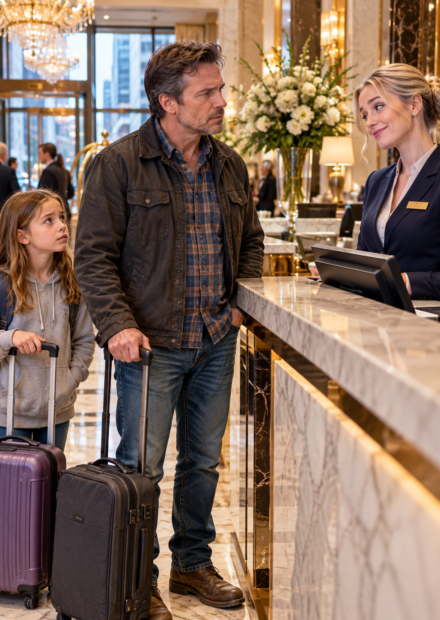
My son had not spoken to me in twelve years, but the morning after a newspaper reported that I had purchased a twelve-thousand-square-foot mansion, he appeared at my front door with his wife, two suitcases, and the grandchildren I had been kept from seeing.
That was how I knew he had not come merely to congratulate me.
People who come to congratulate you bring flowers.
People who come to stay bring luggage.
I stood barefoot in my foyer, staring at the security monitor beside the alarm panel while four people waited beyond my front door.
James looked older.
Of course he did.
Twelve years is enough time to change a face.
His hair had thinned at the temples, and the boyish softness I remembered had settled into the tired lines of a forty-five-year-old man. He wore pressed khakis and a navy polo shirt, the kind of clothes a man chooses when he wants to appear casual while taking something very seriously.
His hands were empty.
The suitcases stood at his feet.
Beside him was Jessica.
She had changed less.
Her hair was shorter, her clothes more expensive-looking, but the expression was exactly the one I remembered: composed, controlled, faintly disapproving, as though whatever room she entered immediately became responsible for meeting her standards.
Then my eyes moved behind them.
My breath caught.
Emma.
Tony.
For one terrible second I did not recognize them.
The last time I had held Emma, she had been four years old and obsessed with a plastic camera that made animal noises whenever she pressed the button. The last time I had rocked Tony to sleep, he had been two and still curled his fist around my necklace whenever he got tired.
Now Emma was sixteen.
Tony was fourteen.
They stood behind their parents on the limestone steps of a mansion they had probably seen first in yesterday’s newspaper.
Emma had dark hair pulled into a loose ponytail. A camera hung from a strap over one shoulder.
I stared at it.
Something inside me cracked quietly.
She still liked cameras.
I hadn’t known.
Tony was taller than I expected, all elbows and long legs, his sneakers planted awkwardly on the front step. He glanced from the front doors to the stone columns to the security camera, clearly unsure where he was supposed to look.
Emma looked directly at the camera.
Then James did.
He smiled.
Not nervously.
Not apologetically.
Warmly.
As though we had spoken last week.
As though there hadn’t been twelve years between us.
As though the last words I had heard from my son had not been, “Mom, I think it’s better if you go.”
I did not open the door.
I watched them wait.
Five seconds.
Six.
Seven.
Jessica glanced toward James.
Eight.
Nine.
Ten.
Maybe that was petty.
I can admit that now.
But twelve years earlier, James had made me wait in pouring rain while he carried my belongings out of his house.
I had been sixty then.
My husband, Frank, had been dead less than five months.
I had been living with James because he had begged me to.
“Just stay with us until you figure things out,” he had said after the funeral.
I had resisted.
He insisted.
“You shouldn’t be alone right now, Mom.”
So I moved into their guest room.
I paid rent.
I bought groceries.
I picked Emma up from preschool.
I watched Tony when Jessica had appointments.
I cooked dinner more nights than I could count.
I stayed out of their way when I sensed tension between them.
And when Jessica told me one evening that they needed “more breathing room,” James promised me I had until the end of the month to find somewhere else.
Three days later, I came home from the pharmacy and found everything I owned packed into two suitcases and a cardboard box that had nearly dissolved in the rain.
James carried them outside himself.
That memory was what finally made me press the button to unlock the front door.
I opened it.
“Mom,” James said.
One word.
I hated how much it hurt.
For half a heartbeat, I didn’t see the man standing in front of me.
I saw a six-year-old boy racing into my bedroom during thunderstorms.
I saw him with scraped knees.
I saw him on the morning of his wedding.
I saw him standing beside his father’s grave, holding my hand so tightly that my fingers hurt.
Then the image disappeared.
I looked at the suitcases again.
“James.”
His smile faltered.
Jessica stepped forward.
“Maggie.”
She opened her arms slightly, as if uncertain whether I would hug her.
I didn’t.
Her arms returned to her sides.
“We saw the article,” she said. “We wanted to congratulate you.”
“Thank you.”
I waited.
No one said anything.
I looked at James.
“Anything else?”
His hands disappeared into his pockets.
Then came back out.
He had done that since childhood whenever he was nervous or hiding something.
“Can we come inside?” he asked. “We need to talk.”
And there it was.
I stepped aside.
The four of them entered.
Jessica’s eyes immediately moved over the marble floor.
Then the staircase.
Then the chandelier.
Then the tall windows overlooking eight acres of gardens.
Tony turned slowly.
“This place is enormous.”
Jessica gave him a look.
“What? It is.”
Emma said nothing.
She was looking at me.
Not the house.
Me.
I wondered what she had been told about me.
That thought followed me all the way into the morning room.
I had bought the house only two months earlier. The newspaper article had made more of it than I liked, mostly because the previous owner had been locally well known and the property had sold for a number reporters apparently considered interesting.
The truth was far less glamorous.
Frank had left me comfortable, but not mansion-comfortable.
The money that changed my life came later.
After his death, I sold our old house, moved into a modest condo, invested carefully, and eventually became an early investor in a medical logistics company founded by the daughter of one of Frank’s closest friends.
I did not become wealthy overnight.
It took years.
By the time my investment became worth enough to change my life, there was no one in my immediate family left who cared to ask how I was doing.
I bought the mansion because I loved the gardens.
That was all.
But apparently twelve thousand square feet had succeeded where twelve years of birthday cards had failed.
It had brought my son home.
We sat.
Jessica surveyed the room.
“It’s certainly a lot of house for one person.”
I almost smiled.
There are women who can insult you using nothing more than square footage.
“What do you want?” I asked.
James rubbed his hands together.
“Things have been difficult.”
Jessica took over immediately.
“James’s work situation has been unstable. Costs have gone up. The kids’ expenses are higher. We’re trying to make responsible decisions instead of waiting until we’re in a crisis.”
I looked at James.
He looked around my morning room.
Then he said the sentence that made twelve years disappear in one ugly second.
“You have more space than one person could possibly need.”
I leaned back.
“You want to move in.”
Jessica raised her chin.
“Temporarily.”
“How temporarily?”
“Six months,” she said.
Then, after the smallest pause:
“Maybe a year.”
I almost admired the nerve.
“Both suitcases for a conversation?” I asked.
James reddened.
“We thought that if you agreed, we could stay tonight and go back for the rest later.”
Of course they did.
I looked at the four of them.
Twelve years.
They hadn’t called when I turned sixty-five.
They hadn’t called when I turned seventy.
When Frank’s sister died, James didn’t answer my message.
When I sent Emma birthday cards, they came back.
When I sent Tony Christmas packages, those came back too.
Eventually their phone numbers changed.
Emails stopped working.
I learned through distant acquaintances that Emma had started high school.
I learned nothing about Tony.
And now, after an article about limestone walls and a twelve-thousand-square-foot house, my family had arrived before breakfast.
“Mom,” James said quietly, “family helps each other.”
The room became so silent that I could hear the clock in the hallway.
I stared at him.
“Is that what you called it when you put my belongings on your porch in the rain?”
Tony’s head snapped toward his father.
Emma frowned.
James closed his eyes briefly.
“Mom.”
“What?”
“That was twelve years ago.”
“I know exactly how long ago it was.”
Jessica straightened.
“Maggie, going back twelve years isn’t productive.”
“Of course you don’t think so.”
Her mouth tightened.
James leaned forward.
“We handled things badly.”
“Badly?”
“I said we made mistakes.”
“You packed everything I owned while I was buying medication.”
“Mom—”
“No.”
My voice surprised even me.
For years I had imagined what I would say if I ever saw James again.
In my imagination I was always eloquent.
Controlled.
Maybe even forgiving.
The truth was less graceful.
“I lived with you because you asked me to. I paid you rent. I paid for groceries. I picked Emma up from preschool three afternoons a week. I watched Tony. I cooked. I cleaned. I stayed out of your bedroom, your marriage, and your finances. And because the two of you were fighting constantly, Jessica decided the problem was the sixty-year-old widow sleeping in the guest room.”
Jessica’s expression hardened.
“That’s not what happened.”
“It is exactly what happened.”
“You were constantly there.”
“I lived there.”
“You had opinions about everything.”
“I had opinions. I did not run your marriage.”
“You made me feel judged in my own home.”
That stopped me for a moment.
Because that part, unlike the rest, had some truth in it.
I had not liked the way Jessica spoke to James when she was angry.
I had not liked watching her criticize him in front of the children.
Once, I had told her quietly that Emma could hear more of their arguments than they realized.
Jessica had never forgiven me.
But there was a difference between disliking your mother-in-law and erasing her from her grandchildren’s lives.
Before I could answer, Emma spoke.
“Dad said Grandma stopped contacting us.”
Everything inside me went still.
I looked at her.
“What?”
Emma glanced at James.
Then back at me.
“He said you didn’t want contact anymore.”
James’s face changed.
It happened so quickly that I almost missed it.
Fear.
Not embarrassment.
Fear.
Jessica rose.
“Emma, this is complicated.”
“No,” I said.
My voice had gone quiet.
“It really isn’t.”
I stood.
My knees felt strangely weak.
I crossed the room toward the built-in cabinet beside the fireplace.
At the bottom was a drawer I rarely opened.
Inside sat a wooden box.
Frank had made it for me during the first year of our marriage. Nothing fancy. Oak. Brass hinges. My initials carved underneath.
I had carried it through three different homes.
More than once I had almost thrown its contents away.
I never could.
I carried it to the coffee table.
Jessica recognized it before anyone else understood.
Her color disappeared.
Tony leaned forward.
“What’s that?”
I opened the lid.
Birthday cards.
Christmas cards.
Letters.
Photographs.
Small envelopes addressed in my handwriting.
Some had never been opened.
Across many of them were red postal markings.
RETURN TO SENDER.
NO LONGER AT THIS ADDRESS.
REFUSED.
Emma reached into the box slowly.
She pulled out a pale purple envelope.
Her name was written across it.
EMMA.
Age Seven.
My throat tightened.
“You sent this?”
“Every year.”
She opened it.
Inside was a card with a little watercolor rabbit holding balloons.
She read silently.
I remembered every word.
Dear Emma,
Seven sounds very grown-up to me. I wonder what you like now. When you were four, you wanted to take pictures of everything, even your cereal. I hope you’re still curious about the world.
Happy birthday.
Love always,
Grandma.
Emma looked at the camera hanging from her shoulder.
Then back at me.
“I still take pictures.”
“I see that.”
Her eyes filled.
Tony had already begun searching the box.
He found a card with a cartoon dinosaur.
I knew that one too.
He had been nine.
He read my handwriting.
His lips stopped moving.
Then he read it again.
“What does it say?” Emma whispered.
Tony hesitated.
Then read aloud.
“I hope someday you know Grandma thinks about you every single day.”
Nobody moved.
Tony looked at James.
“You lied to us.”
James inhaled sharply.
“Tony—”
“You said she didn’t care.”
“I never said she didn’t care.”
“You said she chose to leave us alone.”
“I was trying to explain a situation you were too young to understand.”
Tony held up the card.
“She sent this when I was nine.”
Jessica stepped forward.
“We were trying to protect both of you.”
Emma turned toward her mother.
“From what?”
Jessica said nothing.
Emma’s expression changed.
Not dramatically.
That made it worse.
It was the slow collapse of certainty.
The moment a child realizes the people who taught her what truth means may have been lying.
“From what?” she repeated.
James ran a hand over his face.
“It wasn’t that simple.”
“It looks pretty simple,” Tony said.
“You’re fourteen. You weren’t there.”
“No. Because I was two.”
James flinched.
I looked at him.
For twelve years I had believed the worst thing he had done was remove me from his life.
I had been wrong.
They had rewritten the story for Emma and Tony.
They hadn’t simply told the children that adults had argued.
They hadn’t said relationships broke down.
They hadn’t admitted that they had chosen distance.
They had made me the person who walked away.
The grandmother who stopped calling.
The grandmother who didn’t care enough to try.
I felt something inside me change.
Not break.
Harden.
I closed the wooden box.
“You will not be moving into this house.”
James looked at me.
“Mom—”
“No.”
“Please. Can we not decide everything in the middle of an argument?”
“This isn’t an argument. It’s an answer.”
Jessica grabbed her purse.
“Fine.”
She looked at Emma and Tony.
“Come on.”
Neither moved.
Jessica’s voice sharpened.
“I said we’re leaving.”
Emma held the seventh-birthday card against her leg.
“I want to stay.”
Jessica went pale.
“What?”
“I want to stay.”
“Emma.”
“I want to talk to Grandma.”
“You can talk another time.”
“No.”
That one word came from Emma with such quiet force that even Jessica stopped.
Tony swallowed.
Then he looked at me.
“So do I.”
James stood.
“Kids, this is not the time.”
Tony’s face hardened.
“Then when is?”
James had no answer.
I looked at the two teenagers sitting on my sofa, each holding proof of a childhood I had tried to reach and had been kept from touching.
For the first time since they walked through my door, the size of my house no longer mattered.
The money didn’t matter.
The suitcases didn’t matter.
Because the real thing that had just entered the room was twelve years of stolen history.
And my grandchildren were finally old enough to ask who had stolen it.