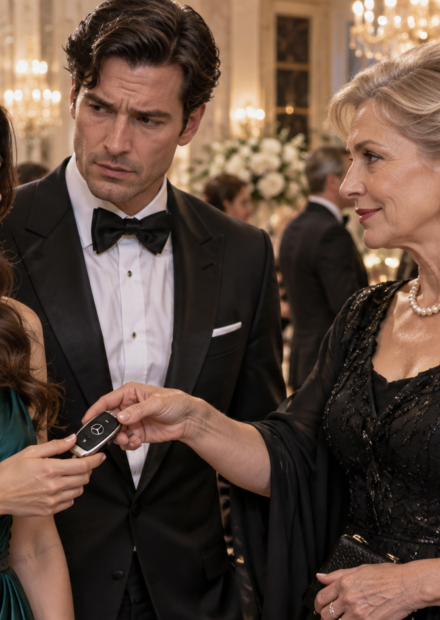
Chapter 3 – IT WAS ALWAYS MY HOUSE
I opened the door but kept one foot behind it.
Jason looked almost triumphant.
The locksmith looked uncomfortable.
“Morning,” Jason said.
“What are you doing?”
“My key doesn’t work.”
“I changed the locks.”
“I noticed.”
He gestured toward the man beside him.
“So I’m getting a key.”
The locksmith cleared his throat.
“I was told this is the customer’s residence.”
“It was,” I said.
Jason’s mouth tightened.
“It is.”
I looked at the locksmith.
“This is a marital dispute.”
That immediately changed his expression.
He stepped backward.
“I’m not getting involved in that.”
Jason turned toward him.
“No, no. Look, my license has this address.”
The locksmith looked between us.
“Do you own the property?”
Jason hesitated.
I opened the folder.
“I do.”
I pulled out a copy of the deed.
The house had been mine before Jason.
I had bought it when I was twenty-eight using nearly everything I had saved since college and a small inheritance from my grandmother.
At the time, it was a modest three-bedroom house with ugly beige carpet and cabinets from the nineties.
I loved it.
I painted walls myself.
Replaced fixtures.
Saved for the hardwood floors.
Jason moved in after we got engaged.
When we married, I never made a point of saying **my house**.
It became **our home**.
There was a difference.
One I had apparently understood and Jason had not.
The locksmith scanned the paper but did not take it.
“Sir, I can’t change or bypass anything if there’s a disputed right of access. You need to resolve it legally.”
Jason stared at him.
“I’m paying you.”
“Not enough for this.”
The man picked up his toolbox.
Jason watched him walk toward the van.
Then turned to me.
“So now it’s your house?”
I looked at him.
“It was always my house. I just never made you feel like a guest.”
The anger that crossed his face was immediate.
“Wow.”
“What?”
“Nothing.”
“No. Say it.”
He laughed bitterly.
“You love this, don’t you?”
“Love what?”
“Finally getting to remind me.”
“I didn’t bring a locksmith.”
“You always do this.”
“Do what?”
“You make me feel like I’m beneath you.”
I blinked.
“There it is.”
“There what is?”
“The part where what you did becomes something I did to you.”
He took a step closer.
“You make more than me. The house is yours. You’re better with money. Congratulations.”
“I have never used any of those things against you.”
“You didn’t have to.”
“That doesn’t even make sense.”
“You act like everything needs your approval.”
“When it involves thousands of dollars from a joint account, yes.”
“You see? You always have to control everything.”
I laughed in disbelief.
“No. I have had to manage everything.”
“Same thing.”
“No, Jason. It isn’t.”
He shook his head.
“You know what? Keep the house.”
“I intend to.”
“You think you can replace a marriage with paperwork?”
“No. I think paperwork makes it harder for you to pretend facts are feelings.”
His eyes hardened.
“This isn’t you.”
I thought about that after he left.
Maybe he was right.
Maybe this wasn’t me.
The version of me Jason knew would have opened the door.
She would have said the locksmith thing was ridiculous but let him inside because she hated conflict.
She would have accepted the roses.
She would have convinced herself the loan to Tyler came from generosity rather than entitlement.
She would have asked Jason to promise he would never do it again.
He would have promised.
She would have believed him.
Then six months later, she would have been cleaning up another mess.
That afternoon, I called a family-law attorney.
Her name was Rebecca Price.
She did not tell me what I wanted to hear.
That was one reason I liked her.
She told me property division depended on more than whose name appeared on something and that marriage created financial questions I needed to take seriously.
But the fact that I had purchased the house before marriage, documented the purchase clearly and kept title in my name mattered.
Jason could not simply arrive with a locksmith because Tyler had announced “half of everything” over beers.
We reviewed accounts.
Credit cards.
Shared expenses.
Transfers.
The money Jason had given Tyler.
The party charges.
Rebecca asked me to start documenting everything.
“Not because every dollar becomes a courtroom battle,” she said. “Because right now you need facts.”
Facts.
I liked facts.
Facts did not apologize with roses.
Facts did not call me controlling.
Facts did not tell me I was ruining a marriage by noticing what was happening inside it.
So I made spreadsheets.
That was what I did for work anyway.
I managed operations for a medical equipment distributor. Inventory, scheduling, vendors, staffing, emergency shipments.
I spent my professional life noticing where resources went.
Somehow I had never applied the same discipline to my marriage.
When I returned to work the following week, my manager told me to take it slowly.
I didn’t.
Work felt almost restful.
Nobody asked me where their shoes were.
Nobody told me the electricity bill had “just slipped their mind.”
When something went wrong, people were expected to fix their part.
At home, Evan got stronger.
His cough faded.
His appetite returned.
Jason began coming to see him.
At first, I supervised.
Then, when I felt comfortable, I let Jason take him to the park for an hour.
We communicated almost entirely about our son.
It was strangely peaceful.
Then I noticed something else.
Money.
My grocery bill dropped.
At first I assumed it was because Jason wasn’t eating at home.
But then I noticed the credit card balance.
No late-night delivery.
No online impulse purchases.
No sports bar charges.
No unexplained convenience-store stops.
No automatic payment for a subscription I had never heard of.
The difference in less than a month was staggering.
One Saturday morning, I sat at the kitchen table with my laptop and compared our average spending from the previous year to my current expenses.
I had expected a difference.
I had not expected hundreds of dollars every week.
There were the obvious things.
Jason ordered food constantly.
He bought drinks for friends.
He replaced electronics simply because something newer came out.
But there were dozens of tiny costs I had stopped noticing.
Forty dollars.
Seventy.
One hundred and twenty.
Again.
Again.
Again.
Money I had been covering because I earned a little more and believed marriage meant not keeping score.
The problem wasn’t that I had supported my husband.
The problem was that Jason had mistaken my support for an unlimited resource.
Melissa came over that evening with takeout.
I showed her the spreadsheet.
She looked at the screen.
Then at me.
“You’re surprised?”
“Don’t.”
“I’m not judging you.”
“You are absolutely judging me.”
“I’m judging him.”
I leaned back.
“I should have noticed.”
“You noticed pieces.”
“And explained every one of them.”
“Yeah.”
I looked toward the living room, where Evan was pushing toy trucks across the rug.
“I thought being a good partner meant not keeping a ledger.”
Melissa took a bite of noodles.
“It does.”
I looked at her.
She set down her fork.
“But there’s a difference between not keeping score and refusing to look at the scoreboard.”
I smiled despite myself.
“That sounds like something you read online.”
“I’m divorced. We get a handbook.”
I laughed.
It felt strange.
Good strange.
The next day, Jason called me.
Not texted.
Called.
“Can we talk?”
“What happened?”
“Nothing.”
“You sound angry.”
“I’m not angry.”
He was.
“What?”
A long exhale.
“Tyler and I had a fight.”
I waited.
“He’s being an asshole about the money.”
“What does that mean?”
“I asked when he could start paying me back.”
“And?”
“He says it wasn’t a loan.”
I sat straighter.
“What?”
“He says I told him not to worry about it.”
“Did you?”
“No.”
The answer came too quickly.
“Jason.”
“Maybe I said he could take his time.”
“That’s different from giving him five thousand dollars.”
“I know.”
“What happened?”
“He said I’m only asking because you got mad.”
I almost closed my eyes.
Of course he did.
Jason continued.
“He said I gave him the money voluntarily and now I’m rewriting history.”
“What did you say?”
“I told him he was full of shit.”
“And now?”
“I’m not staying there.”
Tyler had thrown him out.
Not physically.
But after a screaming argument in which Tyler accused Jason of acting “whipped” and Jason accused Tyler of taking advantage of him, Tyler told him to pack his stuff and find somewhere else to crash.
For perhaps the first time in fifteen years, Jason was learning that loyalty and usefulness were not the same thing.
He sounded devastated.
Part of me felt sorry for him.
That frightened me.
Because sympathy had always been the door he used.
“Where are you staying?”
“My brother’s for now.”
“Okay.”
“Claire.”
“What?”
“I know you don’t care—”
“I do care.”
He went silent.
“I just don’t know what you expect me to do about it.”
“I don’t know.”
Neither did I.
Two nights later, he showed up at the house.
No flowers this time.
No locksmith.
He looked exhausted.
His clothes were wrinkled.
For the first time since I had known him, Jason looked like a man who had run out of people willing to make his life easier.
“I cut Tyler off,” he said.
I leaned against the doorframe.
“Okay.”
“I mean it.”
“Okay.”
“I blocked him.”
I nodded.
He looked frustrated by my lack of reaction.
“I know that doesn’t fix everything.”
“No.”
“I want to.”
I didn’t answer.
He swallowed.
“I’ll do therapy.”
My eyes lifted to his.
“I’ll help around the house. I’ll do pickups. Groceries. Whatever. I know I screwed up.”
“Do you?”
“Yes.”
“With what?”
He stared at me.
“The party.”
My heart sank.
He saw it.
“And the money,” he added quickly. “Obviously.”
I waited.
“And not being at the hospital.”
I stepped aside.
“You can see Evan.”
Hope flashed across his face.
“But you’re not moving back in.”
It disappeared.
“Claire.”
“No.”
“For how long?”
“I don’t know.”
He rubbed both hands over his face.
“What do I have to do?”
I looked at him for a long time.
“That’s the problem, Jason.”
“What is?”
“You think there’s a list.”
“There has to be something.”
“Maybe there is.”
“Then tell me.”
I thought about the hospital.
The party.
Tyler.
The money.
The locksmith.
Finally I said, “I need to know whether you want to change because you understand what you did or because you hate what happened to you afterward.”
He stared at me.
“I don’t know what that means.”
“I know.”
I walked upstairs and brought Evan down.
The second he saw his father, he smiled.
“Daddy!”
Jason’s entire face changed.
He knelt and opened his arms.
Evan ran into them.
Watching them hurt.
Because there was love there.
Real love.
And for the first time, I understood that love could be real and still not be enough.
For the next four weeks, Jason became the husband I had been asking him to be for years.
And that almost broke me more than anything else.