Chapter 3 – THE PRICE OF A BOUNDARY
Christmas morning arrived wrapped in silver light and strained politeness.
Lily woke first.
I heard her running down the stairs before seven.
“Grandma! Santa came!”
For one beautiful second, nothing else existed.
I put on my robe and followed her into the living room.
Mason appeared behind us, hair sticking straight up on one side.
Julian came down carrying coffee.
Brooke followed last.
She looked tired.
Not ordinary tired.
The kind of tired that comes from arguing after midnight.
I knew because Julian looked the same.
Still, we managed.
Children have a remarkable ability to demand the present moment.
Lily screamed over a drawing set.
Mason tore wrapping paper into pieces so small that I knew I would be finding them under furniture in February.
Julian laughed when I gave him the same brand of work gloves Richard used to buy him every year.
For a while, Brooke softened too.
She had chosen a beautiful cashmere scarf for me.
“Thank you,” I said.
“You’re welcome.”
Our eyes met.
There was a conversation inside that silence.
Neither of us began it.
Not yet.
I had bought Brooke a silver bracelet weeks earlier.
For half a second, I considered whether giving it now made me weak.
Then I became irritated with myself.
Kindness was not weakness.
The problem had never been generosity.
The problem was obligation.
I handed her the box.
Her face changed when she opened it.
“It’s beautiful.”
“I’m glad you like it.”
“Elaine…”
I waited.
But Lily shouted from across the room, and the moment disappeared.
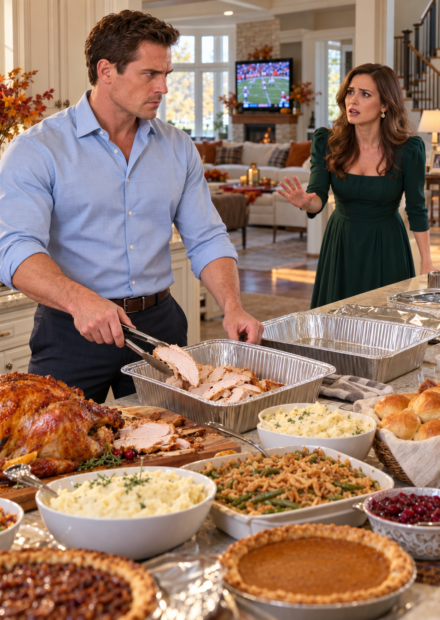
By noon, the house smelled like rosemary, butter, and the cinnamon rolls I made every Christmas.
Richard had always handled the turkey.
After he died, I almost stopped making one.
Then Lily asked why there was no “giant Christmas chicken,” and tradition survived.
Julian helped without being asked.
He peeled potatoes.
Cleaned pans.
Kept Mason from stealing rolls.
Brooke spent nearly an hour on the phone with her mother.
I did not listen deliberately.
But I heard my name.
Twice.
That afternoon, while the turkey rested, I went upstairs to change.
When I returned, Brooke was alone in the kitchen.
She was pouring wine.
She looked at me.
“We should talk.”
“All right.”
She took a sip.
“I didn’t know how much Julian was letting you pay.”
The wording caught me.
“Letting me?”
“You know what I mean.”
“I’m not sure I do.”
She closed her eyes briefly.
“Fine. I didn’t know you were covering that much.”
“Did you know about some of it?”
“The phones. The gas card, sort of. The warehouse membership.”
“And the rest?”
“No.”
I believed her.
That mattered.
It did not excuse everything.
But it mattered.
She leaned against the counter.
“I grew up in a family where people helped each other.”
“So did I.”
“My mother watched my sister’s kids constantly.”
“I’m not your mother.”
Her jaw tightened.
“I know.”
“And perhaps your mother wanted to.”
“She did.”
“Then that was her choice.”
Brooke looked into her wine.
“We don’t treat everything like a transaction.”
“Neither do I.”
“It feels like you do now.”
I pulled out a chair.
“Sit.”
She hesitated.
Then did.
I sat across from her.
“I have never charged Julian interest. I have never asked to be paid back for the groceries I bought, the trips I covered, the birthday parties, the emergency checks, the children’s camps, or the repairs. I don’t keep a ledger of love, Brooke.”
She said nothing.
“But there is a difference between keeping score and noticing a pattern.”
Her fingers tightened around the stem of the glass.
“You think we use you.”
“I think you became accustomed to me saying yes.”
“That’s not the same thing.”
“No. It isn’t.”
She looked almost surprised.
I continued.
“I also think I trained all of you to expect it.”
That made her look up.
“I made it too easy. Julian needed something, and I solved it. You needed childcare, and I often said yes. Plans became inconvenient, and I adjusted them. Nobody had to think much about what things cost me because I rarely told you.”
Brooke watched me.
“My time included.”
Her mouth tightened.
“There it is.”
“What?”
“The babysitting.”
“Yes.”
“I apologized to Julian for what I said.”
“You did not say it to Julian.”
Her cheeks flushed.
“You want an apology.”
“I would appreciate one.”
“Would it change anything?”
“That depends on why you give it.”
For several seconds, she stared at me.
Then she pushed back her chair.
“I knew this conversation was a mistake.”
“Brooke.”
She stopped.
“I am not asking you to humiliate yourself.”
“It feels like you are.”
“That feeling may be worth examining.”
She turned.
There was hurt in her face now.
Real hurt.
“You have never liked me.”
The accusation surprised me enough that I laughed once.
Not cruelly.
Simply because it was so far from what I expected.
“That isn’t true.”
“You tolerate me because Julian married me.”
“I have been frustrated with you.”
“Exactly.”
“That is not the same thing.”
She folded her arms.
“You think I’m spoiled.”
“Sometimes.”
Her eyes widened.
“You think I’m demanding.”
“Sometimes.”
“You think I’m a bad mother?”
“No.”
That stopped her.
I stood.
“You love those children fiercely. I have never doubted that.”
Brooke looked away.
“You think I’m a bad wife.”
“I think Julian avoids conflict with you.”
“That’s his problem.”
“Partly.”
She turned back.
“And what does that mean?”
“It means people participate in the patterns that hurt them.”
Her face hardened again.
“You’ve been waiting years to say this.”
“No.”
I looked toward Richard’s desk.
“I’ve been avoiding saying it for years.”
That was more honest.
Dinner was mostly peaceful.
Mostly.
Lily told us a twenty-minute story about a girl at school who had accidentally brought her mother’s grocery list instead of her homework.
Mason ate only rolls and a piece of turkey.
Julian made a toast to “finally getting into the new house before New Year’s.”
I raised my glass.
Brooke did too.
After dessert, the children watched a movie.
Julian found me loading the dishwasher.
“Can I show you something?”
He held out his phone.
It was a spreadsheet.
I looked at him.
He seemed embarrassed.
“I started going through our expenses.”
“Good.”
“I had no idea.”
“You said that yesterday.”
“No. I mean I had no idea about any of it.”
He scrolled.
“Delivery. Subscriptions. Apps. Automatic renewals. We’ve got two different photo storage accounts.”
“That seems excessive.”
He laughed without humor.
“It is.”
He leaned against the counter.
“We make good money.”
“I know.”
“That’s the part that’s killing me.”
I wiped my hands.
“What do you mean?”
“I kept telling myself we were stretched because houses are expensive and the kids are expensive and everything is expensive.”
“All true.”
“Yeah, but…”
He looked down.
“We also just don’t pay attention.”
That was difficult for him to say.
I could tell.
I resisted the urge to make it easier.
“We spend like we don’t need to pay attention,” he continued. “Because if something goes wrong, you’re there.”
There it was.
The sentence I needed him to discover himself.
He looked ashamed.
“I’m sorry, Mom.”
I touched his arm.
“I don’t want you ashamed.”
“I am.”
“Then use it.”
He looked at me.
“Shame is useless if you only sit in it.”
A faint smile appeared.
“That sounds like Grandma.”
“My mother was very efficient.”
He laughed.
For the first time in two days, I felt like I was speaking to my son instead of a man trying to keep two women from being angry.
Then Brooke entered.
She saw the spreadsheet.
“What’s that?”
Julian turned the phone toward her.
“Our budget.”
Her expression closed.
“On Christmas?”
“I had time.”
“You had time because I kept the kids occupied.”
He blinked.
“Okay.”
She glanced at me.
Then back at him.
“Can we not spend Christmas doing financial penance for your mother?”
The warmth left his face.
“This isn’t for Mom.”
“Really?”
“Yes.”
He held up the phone.
“This is ours.”
Brooke looked at me again.
I could feel her need to identify an opposing side.
I refused to become one.
“I’m going to check on the children,” I said.
As I walked away, I heard Julian say, “Stop making her the reason.”
I paused just out of sight.
Brooke answered quietly.
“She is the reason.”
“No. She’s the reason we noticed.”
I kept walking.
That distinction belonged to them.
The next two days changed the rhythm of the house.
Not dramatically.
Nobody became a different person overnight.
Brooke was still cool with me.
Julian was more attentive than usual.
The children remained blissfully unconcerned with adult economics.
But my role shifted.
When Mason spilled juice, Julian cleaned it.
When Lily wanted to go to the library, Brooke took her.
When they needed groceries, Julian asked what I wanted added to their list.
Their list.
Such a small phrase.
I began noticing how much of my exhaustion over the years had come not from helping, but from never knowing when helping would be expected.
On the twenty-seventh, I received a notification for a fuel purchase.
Seventy-four dollars.
I stared at it.
Two days remained before the card was cut off.
I almost ignored it.
Then I walked into the living room.
Julian was on the couch.
“Did you just use the gas card?”
He looked up.
“Yes.”
“Why?”
The question made him blink.
“For gas.”
“I understand what gasoline is for.”
He almost smiled.
Then he realized I was serious.
“Habit.”
That answer was immediate.
Honest.
He reached into his wallet.
“I didn’t even think.”
“I know.”
He looked at the card as though he had never properly seen it.
Then he stood.
“Do you have scissors?”
I pointed toward the desk.
He found a pair.
Then cut the card in half.
I watched the two pieces fall into his palm.
“There,” he said.
I felt something unexpectedly painful move through me.
Not because of the card.
Because when he was eight years old, I had taught him to cross the street by making him stop at every curb.
Look left.
Look right.
Look left again.
At some point children stopped needing reminders.
At least, they were supposed to.
Perhaps adulthood was simply teaching them again in more expensive ways.
“Thank you,” I said.
That evening, Brooke cornered me in the dining room.
The children were upstairs.
Julian was in the shower.
She spoke quietly.
“You’re enjoying this.”
I looked at her.
“Excuse me?”
“Watching him realize all the ways he depends on you.”
“No.”
“I see your face.”
“What do you see?”
“Satisfaction.”
I considered the accusation.
“I’m relieved.”
“That’s the same thing.”
“No.”
“Close enough.”
She stepped nearer.
“You have no idea how stressful the last few months have been.”
“Then tell me.”
That seemed to unsettle her.
“What?”
“Tell me.”
She stared.
So I waited.
Finally, she spoke.
“The move cost more than we expected. The house needed changes. The kids had activities. Julian was working constantly. I was handling the school transfer, packing, paperwork, contractors, everything.”
I nodded.
“And now the closing is delayed and we’re living here out of boxes and every decision I make gets judged.”
“By whom?”
“You.”
“I have said almost nothing about your decisions.”
“You don’t have to.”
That interested me.
“Brooke, did you feel judged before this week?”
She looked away.
That was answer enough.
I softened.
“I think you believe I disapprove of you.”
She gave a bitter laugh.
“Don’t you?”
“Sometimes.”
“Great.”
“But not for the reasons you think.”
Her gaze returned.
“I don’t care what you spend on clothes. I don’t care where you shop. I don’t care if you prefer expensive restaurants. You are an adult.”
“Then what?”
“I care when your choices create obligations for me without my consent.”
Silence.
“That is the entire problem.”
Brooke folded her arms tightly.
“You make family sound like a contract.”
“No. Consent is not a contract.”
She stared at me.
Then she said something I did not expect.
“If you stop helping, Julian is going to blame me.”
I understood then.
At least part of it.
This was not simply about money.
She was frightened that my boundary would expose an imbalance inside her marriage.
“He shouldn’t.”
“He will.”
“Has he?”
“No.”
“Then perhaps give him the chance not to.”
Her face changed.
For a moment, she looked younger.
Exhausted.
Less certain.
Then the hardness returned.
“If this damages our family, I hope it’s worth it.”
There was the threat beneath the sentence.
I heard it.
So did she.
I kept my voice calm.
“Which family?”
She frowned.
“All of us.”
“If our family can only remain intact while I say yes, it is already damaged.”
Her eyes flashed.
Then she delivered the blow she had probably been carrying for two days.
“Fine. But don’t expect us to keep bringing the kids around if every visit turns into some lesson about boundaries.”
Pain struck so quickly that I nearly lost my breath.
Lily.
Mason.
She knew exactly where to aim.
For a second, the old Elaine surfaced.
The Elaine who would have surrendered instantly.
Anything for the children.
Anything to keep access.
Anything to restore peace.
Then I remembered Richard.
Generosity means more when nobody is watching.
And my mother.
There is shame in forgetting it was help.
I looked at Brooke.
“You should never use your children to win an argument.”
Her face went pale.
“I didn’t—”
“Yes, you did.”
“I said—”
“I heard you.”
Footsteps sounded in the hallway.
Julian appeared.
His hair was still wet.
“What happened?”
Brooke turned away.
“Nothing.”
I looked at my son.
For once, I did not protect anyone from the truth.
“Your wife just suggested I might see less of Lily and Mason if I continue setting boundaries.”
Julian’s expression changed.
Completely.
“Brooke.”
She turned.
“I did not say it like that.”
“How did you say it?”
She looked from him to me.
“I said if every visit becomes this uncomfortable, maybe we won’t come as much.”
“That is not what you said.”
Julian’s voice was quiet.
“Did you use the kids?”
“No.”
“Brooke.”
She looked at him.
His face held something I had not seen before.
Not fear.
Not helplessness.
A line.
And she knew it.
“I was angry,” she whispered.
He stared at her.
“So were you,” she said.
“Not enough to do that.”
She looked at me.
Then away.
Nobody spoke.
Finally, Brooke walked upstairs.
A door closed.
Not slammed.
Closed.
Julian remained in the dining room.
“I’m sorry.”
“You did not say it.”
“She shouldn’t have.”
“No.”
He looked toward the stairs.
Then back at me.
“I’m going to talk to her.”
I nodded.
As he reached the hallway, I said his name.
He turned.
“Do not fight with your wife for me.”
His brow furrowed.
“Then what am I supposed to do?”
“Fight for the kind of marriage you want.”
He stood still for a moment.
Then went upstairs.
I remained alone beneath the chandelier.
My hands had begun to shake.
Not from fear.
From the cost of not giving in.
Boundaries sounded dignified when people discussed them from a distance.
In practice, they hurt.
They disappointed people.
They made rooms cold.
They revealed which relationships had quietly been depending on your lack of them.
I pressed my palms against the table until the trembling stopped.
Then I turned off the dining-room light.
Whatever happened next, I knew one thing.
I would not buy peace with myself again.