Chapter 2 – The Things a Store Remembers
The boiler died the next morning at seven-fifteen.
I knew the exact time because I was standing behind the counter wearing my father’s old gray cardigan over my pajamas, trying to decipher three years of property-tax records while my coffee slowly turned cold.
There was a metallic bang beneath the floor.
Then a groan.
Then silence.
The radiator beside the register stopped hissing.
I stared at it.
“No.”
I touched it.
Still warm.
Five minutes later, less warm.
Ten minutes later, unmistakably cold.
I closed my eyes.
“Of course.”
The temperature outside was nineteen degrees.
According to the television weather report, it was supposed to fall even lower by evening.
I found Ben’s number taped beside the telephone.
Not written recently.
My father’s handwriting.
BEN — SHOP / EMERGENCY / ANYTHING STUPID I CAN’T FIX.
There were two numbers beneath it.
I hated how much the note hurt.
I called.
Ben answered on the fourth ring, voice thick with sleep.
“Yeah?”
“The boiler died.”
A pause.
“Good morning to you too.”
“Good morning. The boiler died.”
“Did you touch anything?”
“No.”
“Claire.”
“I didn’t.”
“Did you go into the basement?”
“No.”
Another pause.
“Why not?”
“Because you just asked me not to touch anything.”
“I asked if you had.”
“You know what? Never mind.”
I heard him laugh quietly.
“I’ll be there in twenty minutes.”
He arrived in eighteen carrying a metal toolbox and two coffees.
I took one without thanking him.
“You look terrible,” he said.
“I’ve been awake since five.”
“You always wake up at five?”
“When I’m working.”
“Your father considered anything before seven an act of aggression.”
“I know.”
Ben removed his coat.
“You sleeping upstairs?”
“Yes.”
“How is it?”
I pretended not to understand.
“Cold.”
“That’s not what I meant.”
I turned toward the basement door.
“Boiler.”
He let me escape.
The basement smelled of concrete, dust, machine oil, and the faint dampness of old Manhattan buildings.
Ben went first down the narrow stairs.
I followed with a flashlight.
At the bottom he reached automatically toward the wall.
“There’s a light pull behind the pipe,” I said.
He stopped.
I stopped too.
Then my hand went around him into the dark and found the cord.
The bare bulb snapped on.
Ben looked at me.
“What?”
“Nothing.”
I scanned the shelves.
The basement hadn’t changed much.
Old paint cans.
Lengths of pipe.
Boxes of fixtures.
A scarred wooden workbench.
I knew where everything was before I consciously remembered knowing.
Ben opened the boiler panel.
“Hand me the half-inch wrench.”
I turned.
Third shelf.
Second drawer.
I opened it.
There.
I handed it to him.
He said nothing.
A few minutes later:
“Needle-nose pliers.”
Workbench.
Coffee can marked PLIERS — NOT SCISSORS.
I found them.
“Flathead.”
Top drawer.
“Wire brush.”
Hook beside the old fuse panel.
After the fourth tool, Ben leaned back on his heels and looked at me.
“What?”
“You remember.”
I felt something tighten behind my ribs.
“I worked here every summer until college.”
“You complained every summer until college.”
“I was sixteen.”
“You complained professionally.”
“I was very advanced.”
His mouth twitched.
For the first time, standing in that basement, I remembered a version of us I hadn’t thought about in years.
Ben at nineteen, leaning against the workbench while my father taught him to solder copper pipe.
Me sitting on the stairs eating a Popsicle and insisting that both of them smelled like burnt pennies.
Ben driving an old Ford pickup through Manhattan traffic with three sheets of plywood strapped to the roof.
My father yelling from the sidewalk that he was going to kill us if the plywood killed us first.
The memory came so clearly that I had to look away.
Ben returned to the boiler.
“Your dad used to say you could find anything in this basement blindfolded.”
“He exaggerated.”
“No. He bragged.”
I stared at the back of his head.
“About me?”
Ben looked over his shoulder as if the question itself surprised him.
“Constantly.”
I said nothing.
He turned back to his work.
Twenty minutes later the boiler coughed, rattled, and came alive.
The pipes above us began knocking.
Warmth.
I let out a breath.
“What do I owe you?”
Ben looked offended.
“A coffee.”
“You brought the coffee.”
“Then you’re paid up.”
“Ben.”
“What?”
“I can afford to pay you.”
“I know.”
“That’s not what this is about.”
“I know that too.”
The answer disarmed me.
He stood and wiped his hands on a rag.
“You still need lights.”
“For what?”
“For the front window.”
“There are lights.”
“Half are dead.”
“People can survive.”
“Not at Christmas.”
I followed him upstairs.
At the storefront window, one side of the old string of colored bulbs had indeed gone dark.
Ben tapped the glass.
“Walter would be embarrassed.”
“My father once left a Christmas wreath hanging until February.”
“That was because you made it.”
“I was eight.”
“It was ugly.”
I stared at him.
He smiled.
“Come on. There’s a wholesaler on Amsterdam.”
“I have work.”
“You’ve been staring at tax records since five.”
“That is work.”
“Exactly.”
An hour later, against every sensible instinct I had, I was walking north with Ben carrying two cardboard boxes of new lights.
The Upper West Side I remembered existed in fragments.
Brownstones with wreaths tied to iron railings.
Corner groceries with hand-painted holiday signs.
Steam lifting through street grates.
Yellow cabs splashing through gray snow at intersections.
Apartment windows glowing above storefronts.
The neighborhood had changed since I left.
There were more expensive restaurants now. Cleaner awnings. Renovated lobbies. Boutiques where practical shops used to be.
But it hadn’t become anonymous yet.
At Seventy-Ninth, a crossing guard shouted Ben’s name.
At Eighty-First, a woman walking a terrier stopped him to ask when he could look at a cabinet door.
At Amsterdam, a superintendent waved from across the street.
“You know everybody,” I said.
“So did you.”
“Not anymore.”
“That’s fixable.”
I looked at him.
“I’m not a broken cabinet hinge.”
“Harder to fix.”
“Thank you.”
“You’re welcome.”
We bought the lights.
On the way back, Ben suggested cutting through Central Park.
“That’s not cutting through.”
“It is emotionally.”
“What does that mean?”
“It means stop walking like someone’s timing you.”
I glanced at my watch.
He laughed.
“That.”
We entered near the West Side.
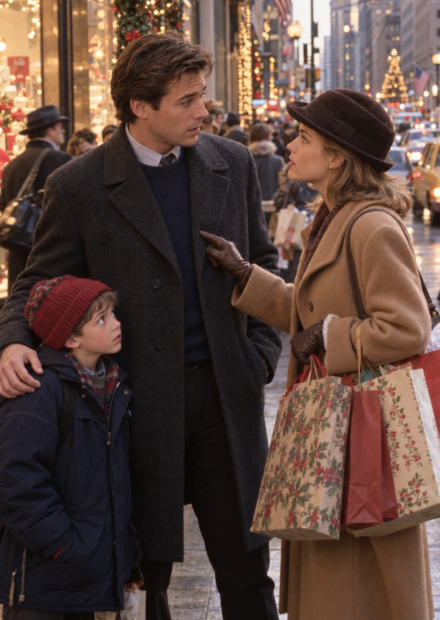
Snow had begun falling.
Not the dirty slush that usually lasted three minutes in Manhattan before turning gray.
Real snow.
Soft flakes catching in Ben’s hair and settling on the shoulders of my wool coat.
The park quieted around us.
Buildings rose beyond bare branches.
For a little while the city seemed farther away than it was.
“You like Boston?” Ben asked.
“Yes.”
“That sounded convincing.”
“I do.”
“What do you like about it?”
“My work.”
“That’s one thing.”
“My apartment.”
“Two.”
“My friends.”
“Three. Look at you.”
I nudged him with my elbow.
“What about you? You never wanted to leave?”
“I left.”
I turned.
“When?”
“Few years after you did. Philadelphia for a while. Worked with a restoration company.”
“You never told me.”
“You never asked.”
The words weren’t cruel.
That made them worse.
“What brought you back?”
“My mother got sick for a little while.”
“Maggie?”
“She’s fine now.”
I exhaled.
“I didn’t know.”
“Claire.”
There was no accusation in his voice.
Just fact.
I looked at the snow.
“I know.”
We walked a little farther.
Then Ben said, “I stayed because I liked it.”
“What?”
“New York. The neighborhood. The work. People act like staying means you failed to imagine anywhere else.”
“I didn’t say that.”
“No.”
“But you think I think it.”
“Sometimes.”
I stopped walking.
He turned back.
Snow collected on his eyelashes.
“I never thought you failed, Ben.”
“Good.”
“I had to leave.”
“I know.”
“You don’t sound like you know.”
He stepped closer.
“I know you had to leave when you were twenty-one. I’m not sure you had to stay gone for nine years.”
The question beneath the sentence sat between us.
I could have answered it.
Instead I adjusted the box in my arms.
“We should get back.”
His jaw tightened slightly.
“Yeah.”
That evening, after we hung the new lights, I finally went upstairs before midnight.
The apartment above Parker Hardware had always been small.
Two bedrooms.
A narrow kitchen.
Living room facing Columbus Avenue.
My father’s bedroom at the back.
Mine at the front.
I had avoided opening my bedroom door since arriving.
That night I did.
And stopped.
It looked like I had left six months ago.
My Columbia pennant still hung crooked above the desk.
A stack of records sat beside the old stereo.
Carole King.
Paul Simon.
Fleetwood Mac.
A photograph of Ben, me, and three friends at a high-school street fair was tucked into the mirror frame.
On the bed was the quilt my grandmother made.
On the closet door hung a red felt Christmas stocking.
CLAIRE.
Crooked white letters.
My mother had sewn it before she died.
I touched the edge.
Behind me, the floor creaked.
Ben stood in the doorway.
I hadn’t heard him come upstairs.
“What are you doing here?”
“Front gate stuck again.”
He saw my face.
His expression softened.
“He kept it like this?”
“You knew?”
Ben nodded.
“For years.”
“Why?”
“He said you might want your records.”
“That’s ridiculous.”
“Probably.”
“He could have boxed everything.”
“Probably.”
My voice cracked.
“Why didn’t he?”
Ben leaned against the doorframe.
“You know why.”
I sat on the edge of the bed.
“No, actually. I don’t.”
Ben didn’t answer immediately.
Then he said, “Because your father missed you.”
I looked down.
“He could have called.”
“He did.”
“I mean—”
I stopped.
Because he had.
Every Sunday.
Usually around six.
If I was home, we talked.
If I was working, he left a message.
Sometimes I called back Monday.
Sometimes Tuesday.
Sometimes not until the following weekend.
I pressed my lips together.
Ben looked at the floor.
“I shouldn’t have said that.”
“No.”
I wiped quickly beneath one eye.
“You should’ve.”
The next morning the toy drive began.
I discovered this when a woman I had never seen before walked into the store carrying three stuffed animals and a boxed train set.
“Where should I put these?”
I looked at her.
“Sorry?”
“For Saint Matthew’s.”
Before I could answer, another family entered behind her.
Then two teenagers carrying board games.
By nine-thirty, the front corner of Parker Hardware was buried under toys.
By ten, someone from the church brought a handwritten sign:
ANNUAL CHRISTMAS TOY DRIVE
DROP-OFF — PARKER HARDWARE
I found Ben across the street eating breakfast.
“You knew about this.”
He looked up from his eggs.
“Morning.”
“You knew.”
Maggie poured me coffee.
“She knows,” I told her.
“Everybody knows.”
“I’m trying to close the store.”
Maggie put the pot down.
“On Christmas Eve.”
“Yes.”
“So until Christmas Eve, it’s open.”
“I need to inventory merchandise.”
“Inventory around the teddy bears.”
I looked at Ben.
He smiled into his coffee.
“This is funny to you?”
“A little.”
I should have gone back and removed the sign.
Instead, I spent the afternoon finding space.
A little girl came in carrying a doll nearly as tall as she was.
An older couple brought puzzles.
A young man in a suit placed two basketballs beside the counter and left before anyone could thank him.
At five, a boy of about ten came in with his mother carrying a wrapped box.
“Mr. Parker here?”
His mother’s face changed.
She knelt.
“Remember, honey? I told you.”
The boy looked toward me.
“You’re his daughter?”
“Yes.”
He held out the gift.
“This is for the drive.”
“Thank you.”
He hesitated.
“Mr. Parker fixed my bike once.”
His mother smiled.
“He gave him a new tire.”
The boy frowned.
“He said it was used.”
“It was new.”
“He lied?”
“To protect your pride,” I said before I could stop myself.
His mother looked at me.
So did Ben, who had just entered carrying coffee.
The boy considered this.
Then nodded solemnly.
“That’s okay.”
After they left, Ben put my cup on the counter.
“You’re getting better.”
“At what?”
“Understanding the ledger.”
I looked toward the growing pile of toys.
I didn’t answer.
That night, after closing, we sat on the floor beneath the front window surrounded by Christmas lights.
Ben plugged in the final strand.
The glass filled with color.
Outside, people walked past and glanced in.
For the first time since arriving, I didn’t see the store as square footage.
I saw layers.
My father behind the counter.
My mother tying my scarf before school.
Ben at seventeen pretending not to wait for me after closing.
A little girl dropping off a doll.
An old man returning forty dollars after eleven years.
Ben sat beside me, his shoulder touching mine.
“You okay?” he asked.
“I don’t know.”
“That’s new.”
“What?”
“You admitting you don’t know something.”
I turned toward him.
He was close.
Closer than I had realized.
For a second neither of us moved.
Snow reflected against the window behind him.
His eyes dropped briefly to my mouth.
My pulse changed.
Then the telephone rang.
We both jerked back.
I stood too quickly.
“I’ll get it.”
I picked up the receiver.
“Parker Hardware.”
“Ms. Parker?”
The voice was polished.
Professional.
I recognized it immediately.
Martin Shaw.
Manhattan Commerce Partners.
“Yes.”
“I wanted to speak with you before tomorrow’s meeting.”
I looked at Ben.
He was winding an extension cord.
“We’ve revised our offer.”
“How revised?”
“Substantially.”
He named the number.
I stopped breathing for a second.
It was nearly twenty percent above the original offer.
Enough to pay every remaining expense on my father’s estate.
Enough to buy the larger Boston apartment I had been considering.
Enough to invest.
Enough to change my life.
“What’s the condition?”
“We need your signature before Christmas Eve.”
I looked through the window at Columbus Avenue.
Martin continued.
“We want access immediately after New Year’s. Demolition preparation begins the first week of January.”
Behind me, the Christmas lights glowed.
Ben looked up.
He knew something had changed from my face alone.
I tightened my hand around the receiver.
“I’ll review it.”
“Of course.”
I hung up.
Ben stood.
“What?”
I looked around the store.
The old counter.
The toy-drive boxes.
The shelves.
The handwritten labels.
Then I said the only thing I was sure of.
“They just made it much harder to say no.”