Chapter 5 – Ask Me After New Year’s
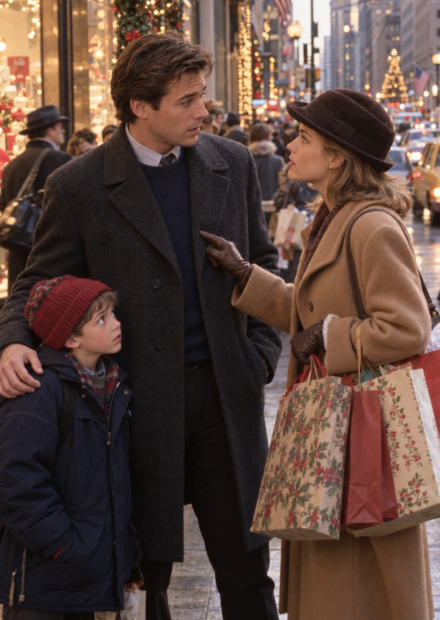
At seven on Christmas Eve, Columbus Avenue looked the way New York always looked in the version people carried in their heads after they moved away.
Snow.
Real snow.
Not yet gray at the edges.
Yellow taxis passing beneath streetlights.
Brownstone windows glowing gold.
Wreaths on doors.
Children in hats and mittens.
Church bells carrying between apartment buildings.
Steam rising from the avenue.
Parker Hardware’s front window shone with the new lights Ben and I had carried through Central Park.
I stood across the street for a moment before closing.
The sign above the storefront was old.
The paint needed work.
One letter in HOUSEWARES had been repaired so many times it leaned slightly left.
But the sign was lit.
Still there.
Maggie came out of the diner carrying her coat.
“You planning to stare at it all night?”
“Maybe.”
“Cold hobby.”
We walked to Saint Matthew’s together.
The church steps were crowded.
Someone had decorated the tree Ben helped raise with hundreds of white bulbs.
The toy-drive gifts had been distributed that afternoon.
Children from the neighborhood chased one another around the sidewalk.
Ben stood near the side entrance talking to Frank Donnelly.
He saw me.
And smiled.
Nothing dramatic happened.
He didn’t cross the crowd.
I didn’t run toward him.
He simply lifted one hand.
I lifted mine.
And somehow that felt more intimate than if he had kissed me in front of everyone.
Maggie noticed.
“Pathetic,” she said.
“What?”
“You two.”
“Motherly support looks different than I remember.”
“I’ve waited nine years. I’m tired.”
I stared at her.
“Nine years?”
She walked away before I could question her.
The next morning, I opened Parker Hardware at nine.
Christmas morning.
Just for a few hours.
Exactly the way my father always had.
I had argued with him about it every year growing up.
“Who buys hardware on Christmas?”
My father’s answer had always been:
“Someone whose sink doesn’t know what day it is.”
At nine-twenty-three, the bell rang.
A man in flannel pajama pants and a parka rushed inside.
“Please tell me you have fifteen-amp fuses.”
I laughed.
He looked confused.
“Sorry. Yes.”
“Our apartment lost half the power. My mother-in-law’s turkey is in the oven.”
“That sounds serious.”
“You have no idea.”
I went toward the electrical aisle.
Ben, who was leaning against the counter drinking coffee, started to follow.
I held up a hand.
“I’ve got it.”
He stopped.
I scanned the shelf.
For half a second, panic.
Then memory.
Bottom row.
Back left.
Blue box.
I reached behind two packages of twenty-amp fuses and pulled it out.
“Here.”
The man looked as if I had handed him oxygen.
“You saved Christmas.”
“Tell your turkey.”
He paid and hurried out.
I turned.
Ben was watching me.
“What?”
“You remembered.”
I looked at the fuse shelf.
Then at the walls.
The worn floor.
The old register.
The sign above the counter.
“I grew up here.”
His smile changed.
Softer.
“I know.”
We opened until noon.
People came in.
Not many.
Enough.
A woman needed batteries for a toy.
A superintendent bought a valve.
Someone from the church returned two folding tables.
Ernie stopped by just to say Merry Christmas.
At twelve-fifteen, I locked the front door.
Ben flipped the sign to CLOSED.
I stood behind the counter.
“So.”
“So.”
“What happens tomorrow?”
“I inventory.”
“Thrilling.”
“And the day after that, I meet with the accountant.”
“Wild.”
“And then I figure out whether this place can make money without my father treating accounts receivable as a charitable suggestion.”
Ben laughed.
“You’re going to collect the ledger?”
“Some of it.”
“Walter will haunt you.”
“He already wrote me a letter from beyond the grave. I think that qualifies.”
I had spent part of the previous night making lists.
Not sale documents.
Possibilities.
Reduce inventory.
Rent the upstairs room eventually.
Repair the storefront.
Hire a manager if I returned to Boston.
Lease part of the rear space.
Maybe specialize more.
Maybe stop trying to stock every screw manufactured since 1948.
Maybe keep the business.
Maybe keep only the building.
Maybe sell in six months.
A year.
Never.
For once, I didn’t need to know yet.
That was the most unfamiliar feeling of all.
My adult life had been built around knowing.
Five-year plans.
Promotion schedules.
Quarterly forecasts.
Closing dates.
I had believed uncertainty meant weakness.
Now uncertainty felt strangely like freedom.
Ben followed me upstairs.
We ate Christmas lunch at Maggie’s.
Turkey.
Mashed potatoes.
Too much pie.
Frank came.
Ernie came after his route.
Sister Anne stopped by.
At one point I looked around the table and realized half the people there had known me since before I could spell my own name.
For years I had told myself that was the reason I left.
Everyone knew me.
Everyone remembered.
There was nowhere to reinvent yourself when the diner owner remembered you stealing sugar packets at seven.
But sitting there, I finally understood the other side of it.
Everyone knew me.
Everyone remembered.
There were places in the world where your absence didn’t erase you.
That evening, after Maggie closed, Ben and I walked.
No destination.
Columbus Avenue had quieted.
Snow crunched beneath our shoes.
Christmas lights glowed from apartment windows.
Somewhere, someone was playing Nat King Cole loudly enough for us to hear through an open hallway door.
We passed Parker Hardware.
I slowed.
Ben did too.
“You know what I hated most about this place?” I asked.
“What?”
“The bell.”
“The door bell?”
“It drove me crazy.”
“Why?”
“Every time it rang, Dad would stop whatever he was doing.”
“That is generally how stores work.”
“No. I mean everything. Dinner upstairs. Phone calls. Conversations. Homework. Bell rang, he went down.”
Ben looked at the dark storefront.
“You thought the store always came first.”
“Yes.”
“And now?”
I watched our reflections in the glass.
“Now I think maybe people did.”
Ben nodded slowly.
“That sounds right.”
I glanced at him.
“Why didn’t you take it?”
“The store?”
“When Dad offered.”
His expression became guarded.
“Frank told me.”
“Frank talks too much.”
“Everybody on this block talks too much.”
“That is correct.”
“Why?”
Ben stared through the window.
“Because Walter was trying to solve a problem that wasn’t his to solve.”
“What problem?”
“You.”
“That’s flattering.”
He smiled.
“I mean what happened after he was gone.”
My chest tightened.
“He worried.”
“About me?”
“About whether you’d come back. Whether you’d feel guilty. Whether you’d sell too fast. Whether you’d keep it for the wrong reason.”
“That sounds exactly like him.”
“He offered me a price I could probably have managed.”
“And you wanted it?”
Ben took a long breath.
“Yes.”
The answer hurt in a strange way.
“Then why not?”
“Because some of it was yours.”
“We could’ve worked that out.”
“Without asking you?”
“You could have called.”
He looked at me.
“So could you.”
Fair.
I looked away.
He continued.
“If I bought it cheap from Walter, even legally, even with you signing whatever papers needed signing from Boston, you would’ve done it because he asked.”
I knew he was right.
“You wouldn’t have thought about whether you wanted something else.”
“I thought I did want something else.”
“Maybe you do.”
I looked at him.
“That’s why I said no.”
He shoved his hands into his coat pockets.
“If you ever came back, I wanted you to get to choose when you were standing here. Not from an office three hundred miles away.”
Snow drifted beneath the streetlight between us.
“You always thought I’d come back?”
“No.”
That answer surprised me.
“No?”
“I hoped.”
I didn’t know what to say.
Ben looked embarrassed for perhaps the first time since I’d known him.
“I’m going to regret saying that.”
“Probably.”
“Great.”
We started walking again.
At West Seventy-Eighth, Ben stopped.
“So when are you going back to Boston?”
There it was.
The question I had known would come.
One week earlier, my answer would have been Christmas afternoon.
Then December twenty-sixth.
Then six weeks from now.
But standing there beneath strings of neighborhood Christmas lights, looking back at Parker Hardware glowing against the snowy block, I realized I no longer wanted my future to sound like a departure schedule.
I looked through the glass of the corner grocery.
At the cab passing slowly behind us.
At the brownstones.
At the store.
Then at Ben.
“Ask me after New Year’s.”
His mouth curved.
“I can wait a week.”
I stepped closer.
“Who said a week?”
For once, Ben Miller had no immediate answer.
I enjoyed that for approximately two seconds.
Then he kissed me.
It wasn’t the kind of kiss that promised everything.
That would have been too easy.
We still had nine missing years between us.
I still had a career in Boston.
He still had a life here.
Parker Hardware still had bills.
The developer might call again.
The store might survive.
It might change.
One day I might even sell it.
None of that disappeared because it was Christmas and snow was falling and Ben’s hand was warm against my cheek.
But when he kissed me, I didn’t feel as if I had come home to erase the life I had built somewhere else.
I felt as if I had finally stopped believing I had to choose which version of myself was real.
The girl who grew up above a hardware store was real.
The woman who built a career in Boston was real.
The daughter who left was real.
So was the daughter who came back.
Maybe coming home wasn’t surrendering to your past.
Maybe it was simply standing still long enough to decide what part of it belonged in your future.
Ben pulled back slightly.
“You’re thinking.”
“I do that.”
“Dangerous habit.”
“I’m very advanced.”
He laughed.
I looked past him.
Parker Hardware & Housewares stood under its old painted sign.
The Christmas lights glowed in the window.
Snow settled on the awning.
A yellow cab passed, briefly washing the glass in headlights.
Upstairs, my childhood window glowed from the lamp I had forgotten to turn off.
For nine years, I had thought moving forward meant refusing to look back.
That Christmas, I learned the two directions were not always opposites.
Sometimes you looked back because you had finally become strong enough to choose what came with you.
Ben took my hand.
We walked toward the store.
And on Columbus Avenue, beneath snow and Christmas lights and the sound of distant church bells, Parker Hardware was still shining.
Not forever.
I wasn’t ready to promise forever.
But it was there tomorrow.
For now, that was enough.